
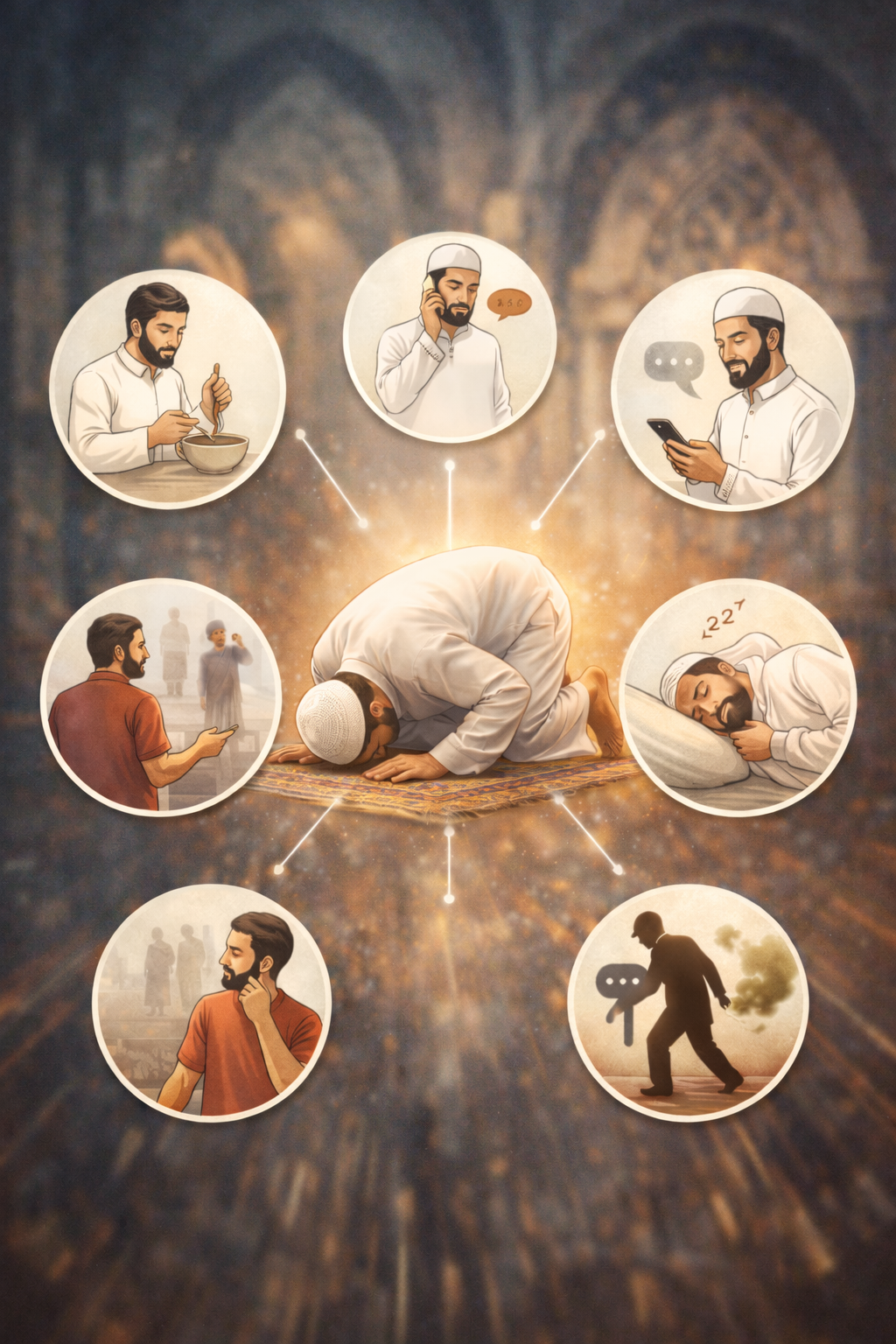
Prayer Invalidators: A Clear Guide to Protecting Your Prayer Without Anxiety
Meta Description (EN):
Learn what invalidates prayer in Islam with a clear, calm guide. Understand common mistakes, doubts, and how to protect your prayer without anxiety.
Prayer is the most consistent act of worship in a Muslim’s daily life. It is performed several times a day and closely tied to time, routine, and spiritual focus. Yet many worshippers share a quiet concern:
they pray regularly, but are not always certain whether their prayer is truly valid.
This concern is rarely caused by neglect. More often, it comes from uncertainty, rushing through prayer, or mental distraction. Understanding what invalidates prayer is not about fear or strictness—it is about clarity, confidence, and protecting worship from being lost.
This guide explains the most common prayer invalidators in a practical and balanced way, using everyday examples and avoiding exaggeration.
What Does “Invalidating Prayer” Mean?
Prayer invalidators are actions or conditions that, if they occur during prayer, render it invalid. When this happens, the prayer does not count and must be repeated.
It is important to distinguish between:
- Actions that invalidate prayer completely
- Minor mistakes or forgetfulness that do not invalidate prayer and can often be corrected through the prostration of forgetfulness
Failing to separate these two is one of the main causes of unnecessary anxiety in worship.
1. Deliberate Speech Outside the Prayer
Prayer is built on remembrance and focus. Intentional speech unrelated to prayer invalidates it.
Examples include:
- Responding verbally to someone nearby
- Speaking on the phone
- Deliberately saying worldly phrases
If speech is intentional, the prayer becomes invalid. Speech caused by forgetfulness or ignorance has different rulings, but the general principle remains: deliberate speech breaks prayer.
2. Excessive Movement That Breaks the Form of Prayer
Movement itself does not invalidate prayer. What matters is the amount and continuity of movement.
Minor actions such as:
- Adjusting clothing
- Slight foot movement
- Brief scratching
do not invalidate prayer.
However, excessive or continuous movement—such as repeated walking, constant phone handling, or prolonged distraction—can invalidate prayer by removing its structure and focus.
3. Does Using a Phone Invalidate Prayer?
This is a common modern concern.
- Having a phone in your pocket does not affect prayer
- Repeatedly looking at or handling the phone may invalidate prayer
- Answering calls or messages invalidates prayer completely
Phone use often combines unnecessary movement, speech, and mental disengagement from prayer.
4. Eating or Drinking During Prayer
Eating or drinking during prayer invalidates it by scholarly agreement, regardless of:
- The amount consumed
- Whether it was intentional or accidental
Prayer requires detachment from worldly actions, and eating or drinking contradicts that state.
5. Losing Ritual Purity (Wudu) During Prayer
Ritual purity is a continuous condition for prayer.
If purity is broken during prayer—such as by passing wind or any act that nullifies wudu—the prayer becomes invalid immediately, even if it happens near the end.
For this reason, prayer should be performed with calmness rather than haste.
6. Deliberately Leaving a Pillar of Prayer
The pillars of prayer form its foundation. These include:
- Standing when able
- Bowing (ruku)
- Prostration (sujud)
- Recitation of Al-Fatihah
Deliberately leaving any pillar invalidates the prayer. Forgetting a pillar has different rulings depending on when it is remembered.
7. Intentionally Changing the Order of Prayer
Prayer follows a fixed structure.
Deliberately performing actions out of order—such as prostrating before bowing—invalidates the prayer because it disrupts its essential sequence.
8. Losing or Cutting the Intention During Prayer
Intention resides in the heart and is a condition for prayer.
If a person begins prayer with a valid intention and then internally decides to end it during prayer, the prayer becomes invalid—even if physical movements continue.
9. Doubt and Its Effect on Prayer
Doubt is a major source of confusion for many worshippers.
- Passing or fleeting doubts do not invalidate prayer
- Persistent doubt without certainty may affect validity
The guiding principle is clear:
Certainty is not removed by doubt.
Prayer should not be repeated simply because of uncertainty without clear evidence.
Do All Mistakes Invalidate Prayer?
No. This distinction is essential.
There is a difference between:
- Mistakes that invalidate prayer
- Mistakes that reduce reward
- Mistakes corrected through the prostration of forgetfulness
Understanding this difference removes unnecessary stress and brings confidence to worship.
Why Knowing Prayer Invalidators Matters
Prayer is repeated daily. When mistakes go unnoticed, they may result in:
- Effort without effect
- Reduced reward without awareness
Knowing what invalidates prayer does not complicate worship—it protects it and transforms prayer from routine into mindful devotion.
Conclusion: Clarity Brings Peace to Worship
A valid prayer is not based on timing alone or physical movement alone. It is built upon:
- Clear intention
- Correct structure
- Awareness and calmness
The clearer your understanding of prayer invalidators, the stronger your focus becomes—and the less anxiety you carry after prayer.